Showing posts with label science. Show all posts

Wednesday, 23 September 2015

We have lift off

That's right, you guessed it we have embarked on a space exploration inspired by Space Week from Camp Google

The experiments so far in camp google have been a bit hit and miss requiring a lot of equipment, and often more complex than they need to be.  So we have started doing our own thing inspired by the camp.  We went to children's section of the Nasa website which has a plethora of information, experiments, videos and games to engage in the subject.

This inspired exploration of satellites, what they comprise of and how they get into and orbit the earth.  A few YouTube videos and a section with information later and we have a Minecraft space station and a cardboard satellite ready for orbit.  Though Autumn was extremely upset at finding out it would cost £10,000 to get it to orbit.


Space Station


Autumn's Satellite


Further adaptations to the satellite

Next we plan on going to the library and seeking out further things on this subject, and watching "How to build a planet"
 and "How to build a universe" 


by the BBC again.

Since this weekend (27th September 2015) there was an amazing event in our skies - The Super Lunar Eclipse, this seems like an excellent place to begin more work on our project.

Below are some links I'm going to be using to shape this project.


Thursday, 25 September 2014

Future Learn: Basic Science ~ Understanding Experiments

We have begun our very first Open University course this week.  It is ideal for home educators, and involves simple household equipment.  This is the link if you are interested in joining in:


This was our Potato experiment.  Trying to work out the water content of a potato.  We discovered this potato was fully dehydrated after 6 minutes of cooking in the microwave, when it promptly burst into flames. Using simple calculations derived from the mass difference we established that the potato had a water content of 90%  This was the children's first experience of using a simple xy axis analysis graph.


In the next experiment we looked at what happens to cucumber when allowed to rest in saline solution and distilled water.  We were left with a flabby and lighter cucumber slice in the saline and a denser heavier cucumber slice in the distilled water.  We have yet to discover why....

We have begun our very own field journal, where notetaking is made.  Quite exciting to have something like what the researchers use. We look forward to the next 3 weeks of the course, and probably courses in the future on other subjects.

When looking over the results and the notes we discovered that we were learning about the process of Osmosis and how liquids like to be at an quilibrium but if there is a semi permeable membrane in the way there is a possibility that the liquids cannot pass through from one place to another because the size of the parts are too big - we used a sieve and a colander to demonstrate this on a practical level.

WEEK 2

This week we learned about properties of solids and liquids, and their corresponding densities. Using an ice tray and some liquids as well as a freezer.  See the picture below for our results.


We learned that whilst water in its solid state (ice) decreases in density, and therefore floats, this is due to the hexagonal structure that is created when it freezes which takes up more room than the water molecules in their liquid form.  This is, however, unique to water, and is not found in other liquids, whose solids would sink in their liquid form.  Sadly, as both the extra liquids we chose were water-based - despite my best efforts to persuade them to use other liquids, we only saw this difference in Olive Oil.  The demonstration on video showed this happen with honey though, so the children witnessed this, even though it was secondhand.

WEEK 3

This week we are looking at conditions necessary for living and thriving.  We are doing this with really basic organisms - yeast.

Monday, 25 August 2014

End of Year Report

I thought it would be fun, and a nice record to do a not-school report for my kids, since they won't get them any time soon.  (To be clear, I'l be writing it in school style with my tongue firmly in my cheek, but the essence of this still stands)

Evan has made huge progress this year in his ability to connect with others.  Ranging from developing new friendships without adult support; relating to known adults in a competent, relevant and fluent way; and willingly show skills to known and unknown people.  This was particularly exemplified in the final term with the excitement he found in performing in his ballet exam, and on stage at HESFES, doing both a dance routine, and a loom band demonstration. His understanding of the needs and feelings of others has taken tremendous steps forward.  He shows this through his need to help Autumn when she is upset, and come up with plausible helpful solutions to the difficulties she has encountered.

Evan is developing his leadership skills, and is able to see the relevance and importance of listening to the ideas of others.  He is able to compromise his intentions and goals in order to gain support from others, and give them an opportunity to play an active part in the game.  Evan's core friendships have also developed and he has become adept at playing different roles with different friends, and also in different environments, according to that which would seem most helpful to him and his friends.  For example, when attending Forest school, he enjoys his time with friend Tom, and doesn't play so much with his other good friend Oscar, who seeks out different playmates at this time.

This year has been the year of new things for Evan.  He began ballet and tap classes along with Autumn and his friends, which he thoroughly enjoys, and is eager to improve his skills.  He practices around the house regularly.  He worked on projects, such as Rivers, Tigers and Guinea pigs.  In which he partook in some formalised learning through worksheets, as well as more concrete learning like in the rivers project, and here, here, and here.  Whilst he enjoyed these projects, much of the learning that goes on is much more fluid (pardon the pun) and unplanned.  Evan also began Forest School which he thoroughly enjoys, along with his friends and sister. This experience is challenging him to develop friendships and demonstrate leadership qualities in less familiar surroundings.

With regards to his academic achievements, Evan continues to be fascinated by science and engineering.  He constantly seeks out opportunities to satisfy his hunger to find out how and why.  His progress reading has been in phases.  There are times when he is really interested in working on Reading Eggs program, but struggled to make the connections between that and reading other things.  He has also worked through the whole of "Teach my monster to read", a phonics based program which built on some of the things he was learning with Reading Eggs.   A new reading set of reading books enticed him to read to his sister, and he enjoyed this.  He found it difficult to read books where he was expecting something in particular to happen, as he liked to make his own version of events rather than connecting the pictures and writing more closely.  This is definitely something to bear in mind with regards to exposure to new reading opportunities.  He has done a number of reading eggs worksheets as well, though I don't feel this added much to his confidence and overall abilities.


Monday, 23 June 2014

Clumber park, cycling, microscopes and squirrels

A change of timetable this week let to a free day on Monday.  I thought a great opportunity to get to grips with the organisation of drawers in the living room.  the kids, on the other hand had other plans - an outing was in order, and since Evan has been keen on cycling later I suggested going to Clumber park, which I know has some great flat cycling routes.  I hadn't been since I was a child, but it was a good opportunity to take advantage of the beautiful weather we've been having lately.

We took the bikes and trailer, as I didn't feel Evan would get much of a cycle if we were hampered going at Autumn's pace.  We chose the shortest route around the park, which was a circuit of the lake, which I presumed had to be pretty flat.  It was billed at 5 miles, I thought that was pretty doable. We head of with a little trepidation as Evan is a bit nervous of junctions on roads, but I managed to convince him that the junctions we were encountering were nice and empty of traffic ( thankfully they were), and after a little shaky start we head off.  We chatted as we went about what we saw, a lovely freedom of cycling together with someone.

I got to thinking on our journey round the lake, about how much learning was going on during this day.  An idea I was drawn back to later in the day during a conversation with someone about how we home educate.  I was asked... "I bet it's hard to do home schooling on a day like this."  my reply was, "on the contrary, we did a tonne of it on our trip out today."  I then went on to list a few of the things that sprung to mind which would directly translate to the school education system curriculum, like Biology - exploring habitats of animals and small creatures, using the skull of a mammal to discover what it is, what it might eat, where it might live.  We also were exploring the laws of physics through the bouncy seesaw, and how to get up a hill successfully when cycling, versus how to find the process too difficult, how to get a swing going with someone else suing weight shifting.  We engaged in no written work, but that didn't mean the learning processes were any less important.  On the contrary, I feel that the learning taking place today, and every day, allows true and honest  organic engagement with the subject matter, exploring it to the level felt appropriate at the time, leaving a far greater and lasting impression that learning taking place in a more structured traditional fashion.  It is quite scary at times, and I do sometimes feel nervous about whether the fundamentals of life will be acquired, but then we have days like today which remind me to allow the children to enjoy their childhood and give them the space to be themselves and explore at their own pace.  In my heart I know and trust that they really will learn all they need to learn.


Back to Clumber Park... here we see Evan feeding this squirrel.  I felt a little uncomfortable about this, because of the close contact, but as it was safe enough, and risk levels fairly low, I let it go.  He loved it.


We nearly passed the Discovery centre, as it was a small entrance, and we planned to go on another cycle.  I was so glad we popped in.  It was really a discovery centre (we've been in a few discovery centres before which are less discovery, more a few photos).  Loads of interesting interactive displays, child-friendly microscopes with loads of slides.

 Teamwork

We are really excited about Clumber park, we'll be back soon.  We will definitely going to look into a Home Educators National Trust membership.  


Friday, 13 June 2014

Science club: SOUND

Today was science club.  We did loads of activities and experiments about sound.  We used the following books for our experiments - Usborne 100 Science experiments, Super Science Experiments and Make it Work! Sound. The authors and publishers of which we are very grateful.

We started off by exploring the garden trying to make the largest sound possible with just one bang.  They started small by just exploring the musical instruments, but then explored further by going round the garden.  They discovered that the wheelbarrow was the loudest they could find when hit with an object.  We discussed a bit about materials, and which ones made the loudest sounds.  Evan found that plastic made the least sound, whilst wood was a bit louder and metal was the loudest.

We followed this by a series of activities which I are shown pictorially below.
We used a sound cannon to blow a candle flame... later we took one end off this and were able to actually blow it out.

We then watched a favourite television program called Miracles of Nature (from 18 minutes in)

the episode concerned with Echolocation. The technology information of which is shown here. We followed this up by trying out our own little bit of echolocation in the garden.

Using our own ability to notice if we were in open or closed in spaces by clicking.  They did remarkably well.  I was very impressed.

The children next had a go at feeling and seeing sound through the effect of the vibrations from a speaker.  This was a real hit, and later they demonstrated how the jewels moved by bouncing on the trampoline.

More seeing the effect of sound through vibrations on a drum - this time sugar on top of a stretched balloon over a glass. All of them loved the end of this activity which involved the tongue doing in the inevitable.
Next we looked at amplification using funnels in the form of making a duck sound using a paper cup, string and a wet towel.  Evan explored what happened without the wetness and without the cup, and found that without the wetness there wasn't the sound at all, and without the cup it was a quiet noise.  Plus, they all made megaphones which were super effective and simple, a great way to feel vibrations of the voice on your lips.

Now this strange looking photo we are demonstrating a tuning fork.  We literally have forks connected to thread wrapped to our fingers which are in turn sitting on our ears.  The sound is transferred and we hear it really loud after we dong the fork onto a hard surface.

We changed the pitch a few times by adding extra water and keeping them at different levels.

The whole session was super quick, and was a platform to inspire and start learning about the subject of sound.  I would hope the children now have a few ideas of how to explore these concepts themselves at their own pace now.  There was a bit of discussion here and there about the scientific conclusions we can make from our findings, but we did keep it fairly light and exploratory.

Friday, 16 May 2014

Science day - Plants

Today, with another family, we did a number of explorations and experiments to explore plants and how they grow.  To plan for this day we have been growing beans with different variables changed.

#1 - Demonstrating oxygen evolution during phosynthesis using Cabomba pondweed

This was such fun, we followed a number of the experiments in the linked to page.


#2  Exploring the variables affecting growth on a bean plant

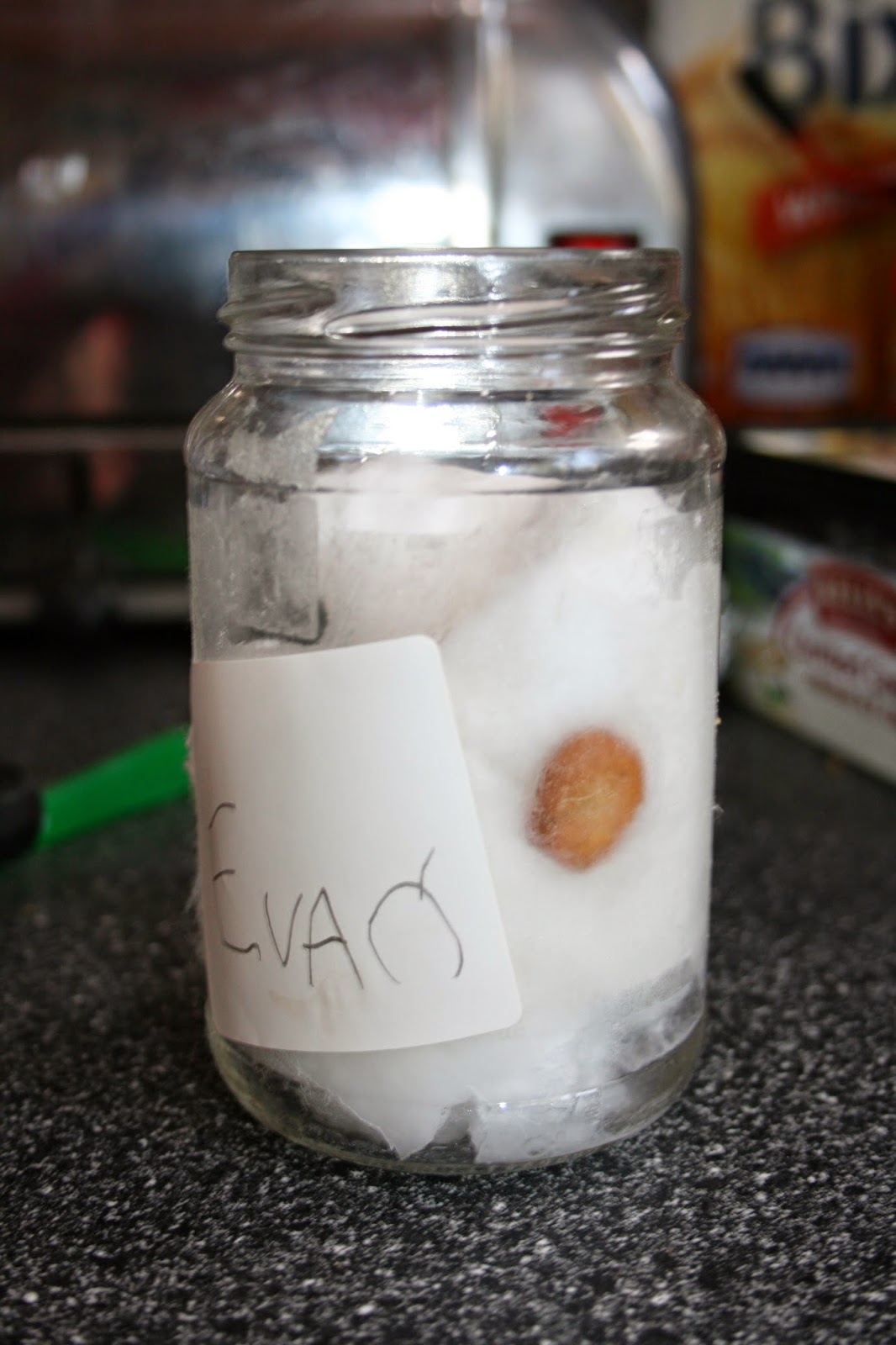
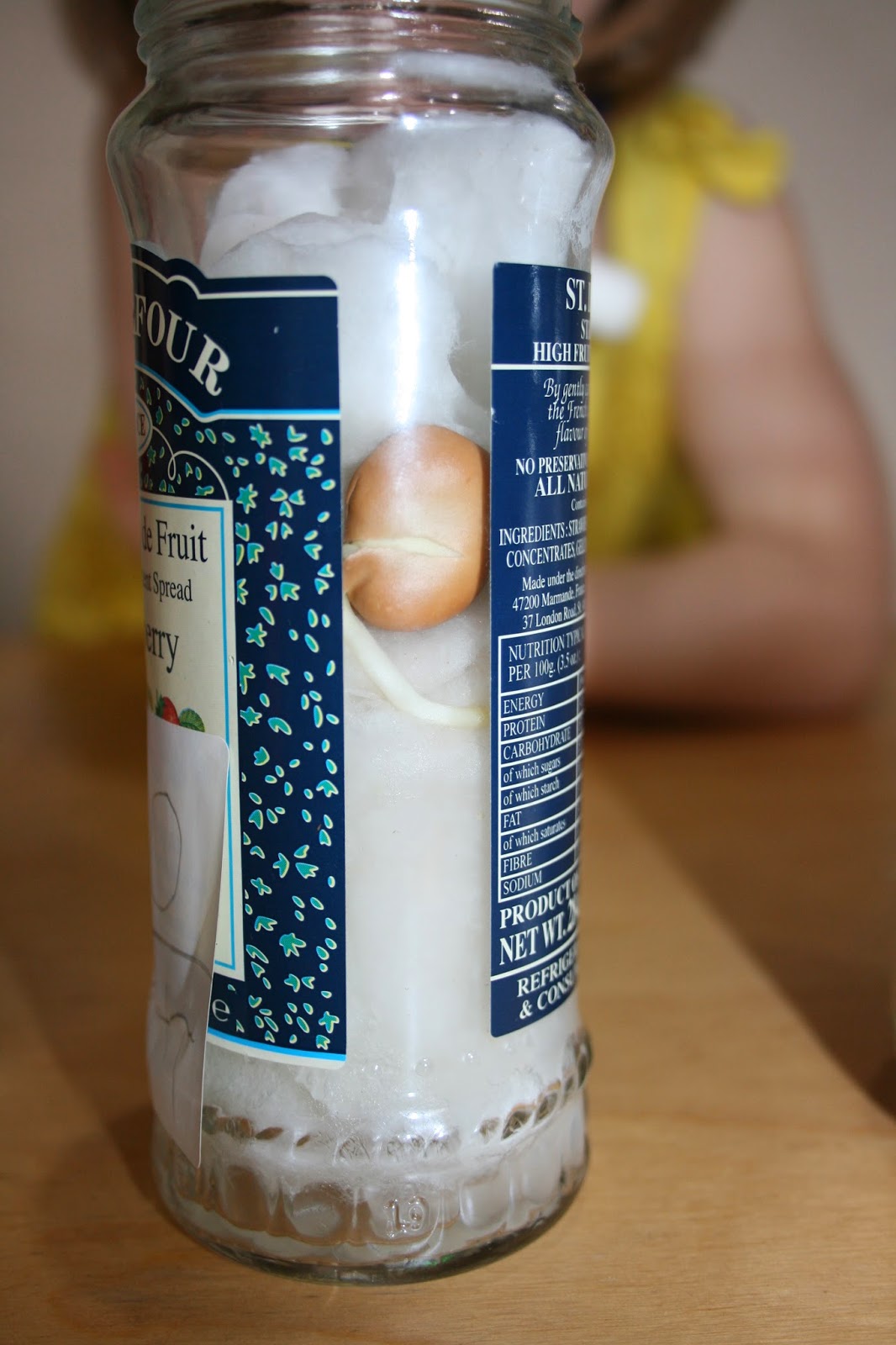
Excitingly our beans planted at the same time about 3 weeks ago showed differences depending on their environment.  The plants germinated at Su's house (warmer and brighter) grew really well, whilst ours failed to thrive. The photographs give an indication of what they were like.  The bean which had been left without water failed to germinate at all, whilst the bean with water but no light germinated and grew quite well, but the small leaves which grew remained small and yellow.  The plant appeared to try hard to find light, seeking out fractions of light at the edge of the cupboard it was in.


#3 Exploring the different parts of a flower


#4 Hapa Zome - Exploring the colours found in plants


Hapa Zome printing is the process of extracting the colour from a plant by bashing and thereby transferring the colour onto fabric underneath.  It was the most wonderful satisfying experience and everyone enjoyed it, including me and Su.


Saturday, 10 May 2014

University Science Day

This Wednesday, Evan had the opportunity to visit the Chemistry department at the University for some experimenting in the School's lab and an Electricity lecture.  During the evaluation he said he had an amazing time and he thought all of it was brilliant.  I was surprised at this, as the afternoon was a lecture on Electricity, which, whilst interesting and interactive, Evan appeared to pay no attention to as he was obsessed with making his newly made slime, touch the floor.  However, my husband mentioned to me last night, that Evan gave his own lecture on Electricity to him with all the elements that were discussed using all the terms correctly and giving examples.  He seemed capable of not showing any outward signs of engagement in a topic, whilst actually taking it all in and understanding the concepts clearly.  He is a keen scientist, so the subject matter helped,  but the level at which his mind is working on these ideas seems beyond what I am capable of fully understanding.  Today, I have been reflecting on my role with this.  Everything we come across to do with Science he seems to understand instantly.  Do I, therefore, provide him with as many opportunities as possible to take on board new science things, or continue allowing him to pick things up when the moment or situation arises that it feel pertinent?  I am not really sure.  My instinct tells me that he will find his way to all the learning he wishes in time, but what stops me is the fact that a lot of the learning that he could do with science may require external skills that he has yet to require, therefore needing me to be more proactive in my approach.

I toyed with the idea of postponing the density exploration until science club next month, but decided instead to do it today.  He said to me on the Science day that he has been inspired by the day and want to do more Science work in the future.  He is most keenly attuned to the fact building rather than experimenting at the moment.

Thank you to all involved in the Science day, it really has given us a lot to think about.

Plant veins in action

Responding to a query of Autumn's the other day about "the weird line" on leaves and stems, we explored this using a simple experiment with a stick of celery and water with red food colouring, a day later and here was the result.

Exploring Density

After spotting the experiment on Nina and the Neurons, Evan said that he would like to explore the liquids that float and sink.  So today was the day.  I started by doing a little research, and found this great video demonstrating density towers.


Good as the video was, I felt that simply replicating it would miss a lot of learning opportunities, so decided to get Evan to create his own density tower by exploring the comparative densities of different liquids he found.

He found:
Water
Milk
Apple Juice
Tomato Ketchup
Sunflower Oil
Vinegar
Washing up liquid
Hair Conditioner
Shower Gel
Aloe Vera Gel

I helped him to explore the comparative densities of the the liquids, all, initially compared to water.  So in glasses we poured out water and each of the liquids.  Before each time, I asked him to make a guess, or hypothesis of what would happen. He varied whether he put the water in first or the other liquid.

As I had watched the video, I had noted that it is important to be careful when pouring on some liquids to prevent inadvert displacement of lower liquids.

We decided to use a blue food colouring in the water to see the distinction between the liquids more clearly after a few liquids got mixed up.

We wrote a chart as we went which placed the different liquids on a scale according to their density compared to each other.  Once we had done this we found a few of the liquids were almost the same density as water and mixed up so that neither colour were distinct any longer.  Namely, vinegar, milk and apple juice.  So we decided to use plain water instead.  Next it was time to differentiate between the liquids which had a greater density than water to see which one we should put on top of each other. Evan guessed that tomato ketchup has the greatest density, so trialled this with putting what he thought was the next, which he thought would be the shower gel.  All his guesses were correct, as it goes, and we simply added them in turn on top of each other, even though we had planned on doing separate little experiments to find out which had the greater density out of two liquids at a time.  Here is the result.


We followed this by exploring the density of solid objects so started by exploring whether objects sunk or floated in water, and then moved on to adding oil on top to see if any of the objects had a smaller density than oil.  This was followed by exploring the greater density objects and liquids together with our findings as shown below.


We both loved looking at the different colours that sat together in this way, and Evan loved it so much he decided he wants a photo of the tower from all angles printed out and stuck onto a tube next for him to have near his bed.  We both noted how amazing the colour of the oil looks, particularly as there appears to be a very strong separation between the oil and water, a kind of film makes the oil base iridescent and very golden.  I think we might go on to have a go at home made lava lamps as an extension of this activity.


Monday, 28 April 2014

Caterpillar life cycle

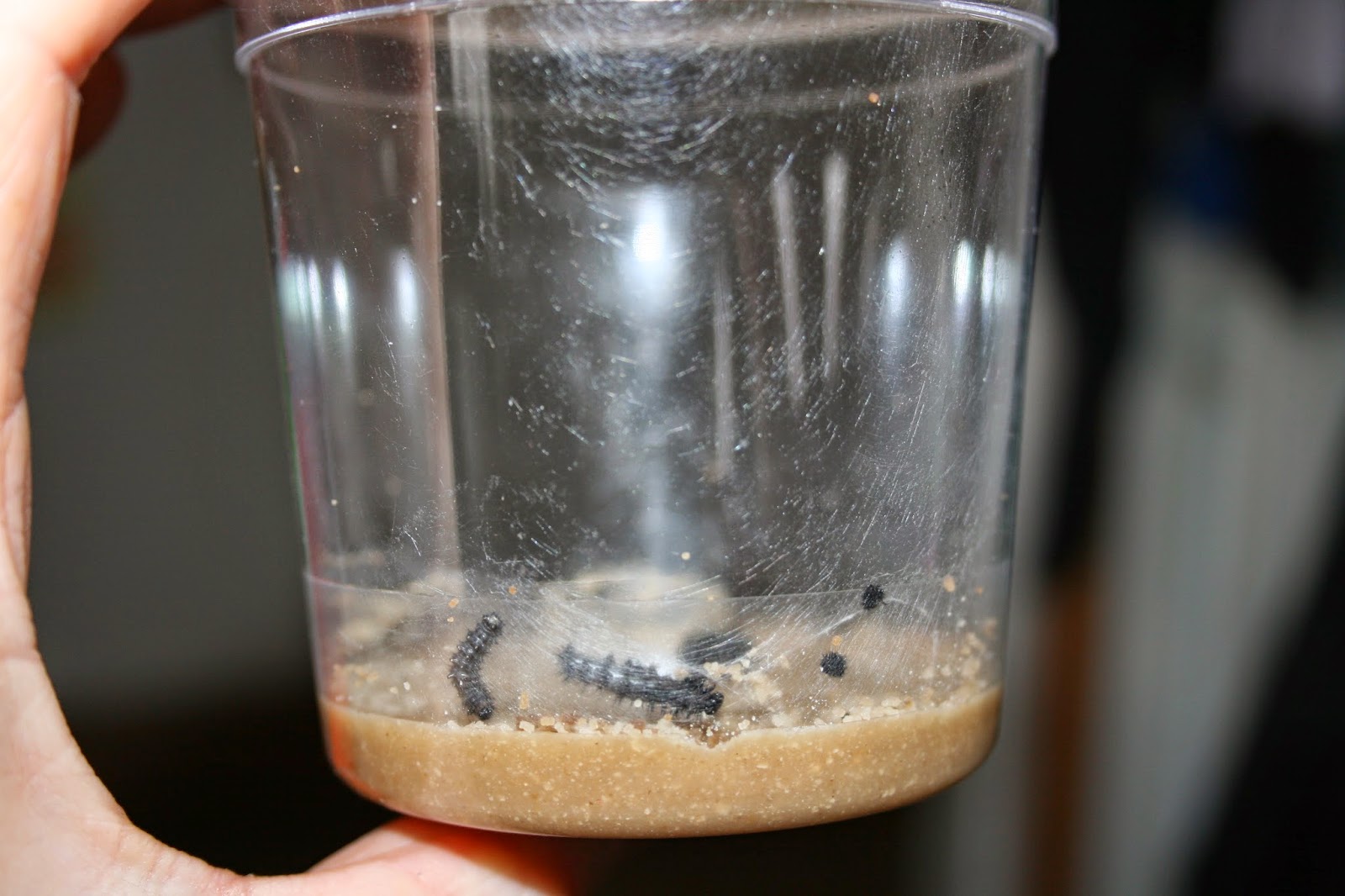
We have decided to observe the lifecycle of the butterfly.  So we bought a kit from Insectlore, which arrived a few days ago.  They are self contained, so they have all their food in a hardened solution on the bottom of the tub which has air holes.  At the top, when they are ready, they go up and become chrysalides and hang off the paper disc at the top, which, when they harden, we place directly into their butterfly home ready for them to emerge.


Here is their picture story.
They have arrived

 Here they are, only quite small.

 Day 2 - here we see most of the caterpillars onto their second exoskeleton and the small one in the middle on its first.  The instructions say that this repeats a number of times before they become chrysalides

Day 3

Day 4 - they are getting quite big now, and seem to have formed a complex network of silk threads on top of their food area.  There is a large number of displaced parts of food and blobs of black.  We have also noticed what looks like a discarded exoskeleton, from the largest of the caterpillars with very clear hairs on it, in a hard ball.  Today they were quite active, and Evan and I watched them.for a while.  We noticed the suckers on the back legs, of which there appeared to be 5 pairs, they move together in an undulating way.  At their front sections which moved around the most, there were 3 pairs. We saw the head weaving around presumably spinning a thread from its spinnerets.  We noted no interaction between the caterpillars, but were amused by one caterpillar who seemed to hang out at the top of the container, and when it moved back towards the food, got half way and went back up again.  We got our microscope out and managed to see them moving close up, which was pretty scary but fascinating.


Been a bit slack in photo taking, but here are some recent shots

Today - they are simply enormous, and there are plenty of "spent" exoskeletons to show their size.  We have particularly been fascinated by their hairs and how their suckers move.  It is now more apparent that they move inwards as they walk, and only the back legs have suckers, the front ones appear to be more feelers than movers - more like hands than feet really.


Tuesday, 22 April 2014

Growing a bean

Next month at Science Club we are exploring plants.  As this will probably require more than instant results we have decided to prepare some things to find out about.  Firstly we are doing an experiment to explore the things necessary for growth.  We planted broad beans as they are nice and easy to see the results.  We have:
Light But No Water
Water But No Light
Light and Water (twice, one each)  Here are our photos on day 0


DAY 7

Water & Light

Water NO Light

Water NO Light

Light No Water 
________________
After 1 week


____________________________________________

After 2 weeks